
Local Lead Generation With Google Ads: A Guide for Australian Service Businesses
Google Ads can fill a removalist’s calendar, a mechanic’s booking sheet or a tradie’s quote list, but only when the account is built around leads rather than clicks. That means tight local targeting, search terms that signal intent to hire, a landing page that makes enquiring easy and tracking that counts real calls and forms. Most wasted spend comes from missing one of those four. At The Google Ads Guy, Andy Winter-style generalism is not the model: you work directly with an experienced specialist who builds and manages the account for service businesses like yours.
TL;DR
- Local lead generation works when you pay for searches from people ready to hire, in the suburbs you actually service, not for broad traffic.
- Location settings, keyword match types and negative keywords decide most of your lead quality before you ever write an ad.
- The click is only half the job: a focused landing page and a fast response turn enquiries into booked work.
- Track phone calls, form submissions and booked jobs, then judge campaigns by cost per qualified lead, not cost per click.
- A specialist-managed account with transparent reporting and no lock-in contract keeps you in control of the budget.
Table of Contents
- Why local lead generation is a different job from general advertising
- Step 1: Decide what a lead is worth before you spend
- Step 2: Build the campaign around intent
- Step 3: Get location targeting right
- Step 4: Send clicks to a page built to convert
- Step 5: Turn enquiries into booked jobs
- Step 6: Track what matters, then diagnose waste
- Step 7: Set a budget you can defend
- How this looks for removalists, mechanics and tradies
- Where a specialist makes the difference
- FAQ
- Sources
Why local lead generation is a different job from general advertising
A national retailer wants reach. You want the phone to ring from people within a 20 to 40 minute drive who need a service this week. Google Ads suits that because people type what they need at the moment they need it: “removalists near me”, “brake repair”, “emergency electrician”. You are not interrupting anyone. You are showing up for a question already asked.
That is also why the model punishes sloppy setup. A single broad keyword can match searches from job seekers, DIYers and people three states away. Each of those clicks costs money and delivers nothing. The aim of a local campaign is to cut the audience down to people who are close, ready and able to pay.
Step 1: Decide what a lead is worth before you spend
Start with arithmetic, not ads. Work out three numbers:
- Average job value. A local house move, a logbook service and a hot water replacement are very different sizes.
- Close rate. Out of ten enquiries, how many become paid jobs? Be honest, including the missed calls.
- Margin. What you keep after labour, materials and fuel.
Here is a worked example with made-up numbers. A mechanic averages a $450 job with a 35% margin, so about $157 gross profit per job. If four in ten enquiries book, one booked job needs 2.5 enquiries. At $157 profit per job, the mechanic can afford to pay up to roughly $63 per enquiry before breaking even, and should aim far lower. Without this sum, “good” and “bad” cost per lead are guesses.
Our guide to cost per lead in Google Ads shows how to benchmark and lower that figure, and the Google Ads cost guide for Australia covers what budgets typically look like.
Step 2: Build the campaign around intent
Choose search campaigns first
For a service business, search campaigns come first because they capture people actively looking. Display and video can have a role later, but they work on interruption rather than intent. Our comparison of display ads and search ads for service businesses explains where each belongs.
Group keywords by service, not by everything you do
A removalist who bundles “house removals”, “office relocations” and “piano moving” into one ad group ends up with ads that say nothing specific. Give each service its own ad group, its own handful of keywords and its own ad copy. A searcher for “piano removalists” should see “piano removalists” in the headline and land on a page about pianos.
Pick match types with care
Broad match gives Google wide latitude to decide what counts as relevant. That can work once an account has solid conversion data, but a new local campaign usually needs tighter control through phrase and exact match, so your budget goes to the searches you chose. Review the search terms report weekly at the start. It shows what people actually typed before clicking.
Build a negative keyword list on day one
Negative keywords stop your ads showing for searches you don’t want. Common ones for service businesses include “jobs”, “careers”, “course”, “training”, “diy”, “how to”, “free” and “salary”. Add to the list every time the search terms report shows a mismatch. This single habit often does more for lead quality than any bid change.
Write ads that filter as well as attract
An ad that says “Free quotes, same-day service, Parramatta and surrounds” invites the right call. An ad that mentions your minimum job size, service hours or specialty discourages the wrong one. Fewer, better clicks are cheaper than lots of curious ones.
Step 3: Get location targeting right
Location is the biggest lever a local business has, and the easiest to get wrong. Two settings matter.
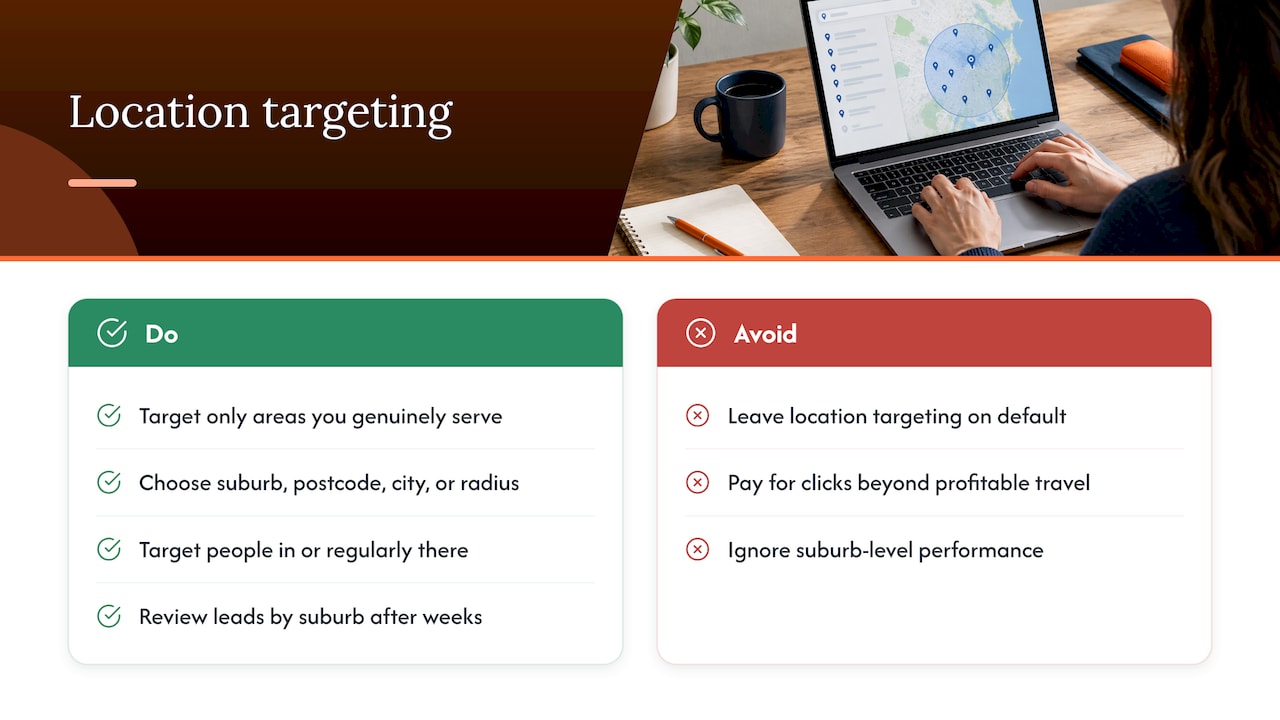
Where you target. You can target by suburb, postcode, city, or a radius around your depot or workshop. Pick areas you will genuinely travel to and that make money. A plumber in Geelong gains nothing from clicks in Melbourne’s north if the travel time wipes out the margin.
Who the targeting includes. Google’s default location option can include people who merely show interest in a place, not just people physically there. For most local service businesses, you want people in or regularly in your target area, so check this setting rather than leaving it on default.
It also helps to look at performance by suburb after a few weeks. You will often find two or three areas producing most of your good leads and others burning budget. Our location targeting guide for Australian businesses walks through the settings in detail.
Your Google Business Profile matters here too, because it shapes how you appear on maps and in local results alongside your ads. Getting the business profile basics for local visibility right means your address, hours, categories and reviews support the ads rather than undermine them.
Step 4: Send clicks to a page built to convert
A click that lands on your home page, with its menu of ten services and a wall of text, gets lost. A landing page for one service and one action performs better. For a local service business, that page typically needs:
- A headline that repeats what the person searched for.
- Your phone number at the top, tappable on mobile, since many local searches happen on a phone.
- A short enquiry form with only the fields you need.
- Proof: reviews, licences, years in business, photos of real work.
- The areas you serve, stated plainly.
- One clear next step, such as “Get a free quote”.
Speed matters too. A slow page loses people before they read a word. We cover this in detail in our guide to landing pages for Google Ads, including what Australian service businesses need on the page. Conversion-focused landing pages are part of how we build campaigns, because the ad and the page have to work as one system.
Step 5: Turn enquiries into booked jobs
A lead you answer in five minutes is worth far more than one you return the next afternoon. Someone searching for an emergency electrician or a tow is often phoning two or three providers in a row, and the first to pick up usually wins.
Some practical habits:
- Answer calls live during business hours, or use a service that does.
- Reply to form enquiries within minutes, not hours.
- Follow up unbooked quotes a couple of times before letting them go.
- Ask each new customer how they found you, and note whether it was an ad.
If you want to automate parts of follow-up, this practical piece on improving lead conversion is a good place to see how businesses structure it.
Step 6: Track what matters, then diagnose waste
Without conversion tracking, Google Ads is a guessing game. You need to record at least:
- Calls from ads, including calls from call extensions and calls from the landing page.
- Form submissions on the landing page.
- Bookings or sales, where you can pass them back to the account.
Our conversion tracking setup guide covers the Australian setup, and the enhanced conversions for leads guide explains how to connect leads to real outcomes so the account learns from the enquiries that become paying jobs. The approach in better Google Ads leads by fixing measurement rests on the same idea: you can only improve what you measure properly.
A simple weekly review
Once tracking works, a ten-minute weekly check catches most problems:
- Search terms. Add new negatives for irrelevant queries.
- Cost per lead by campaign. Which services are cheap to win and which are expensive?
- Lead quality. Were the enquiries real jobs in your area? Mark them honestly.
- Location report. Trim or reduce bids in suburbs that don’t convert.
- Ad schedule. If nobody answers the phone on Sunday, don’t pay for Sunday clicks.
Signs of wasted spend are consistent: lots of clicks and no calls, calls from outside your area, enquiries asking for services you don’t offer, and a cost per lead that creeps up while volume stays flat. Each one points back to targeting, keywords, the landing page or tracking.
Step 7: Set a budget you can defend
Budget should follow your numbers from Step 1. Work backwards: if you want ten extra jobs a month and about one in three enquiries books, you need around thirty enquiries. Multiply by an affordable cost per lead and you have a monthly figure. Start there, then adjust as real data arrives.
A few principles help:
- Set the daily budget high enough for the campaign to show throughout the day, not run dry by 10am.
- Give a new campaign a few weeks of data before making sweeping changes, since constant tinkering resets learning.
- Put more money behind the services and suburbs that already produce profitable jobs.
- Keep a limit on what you’ll pay per lead, and cut campaigns that miss it for a sustained period.
If you want a more structured way to organise this, a local campaign planning playbook can help you lay out budgets, reporting and responsibilities.
How this looks for removalists, mechanics and tradies
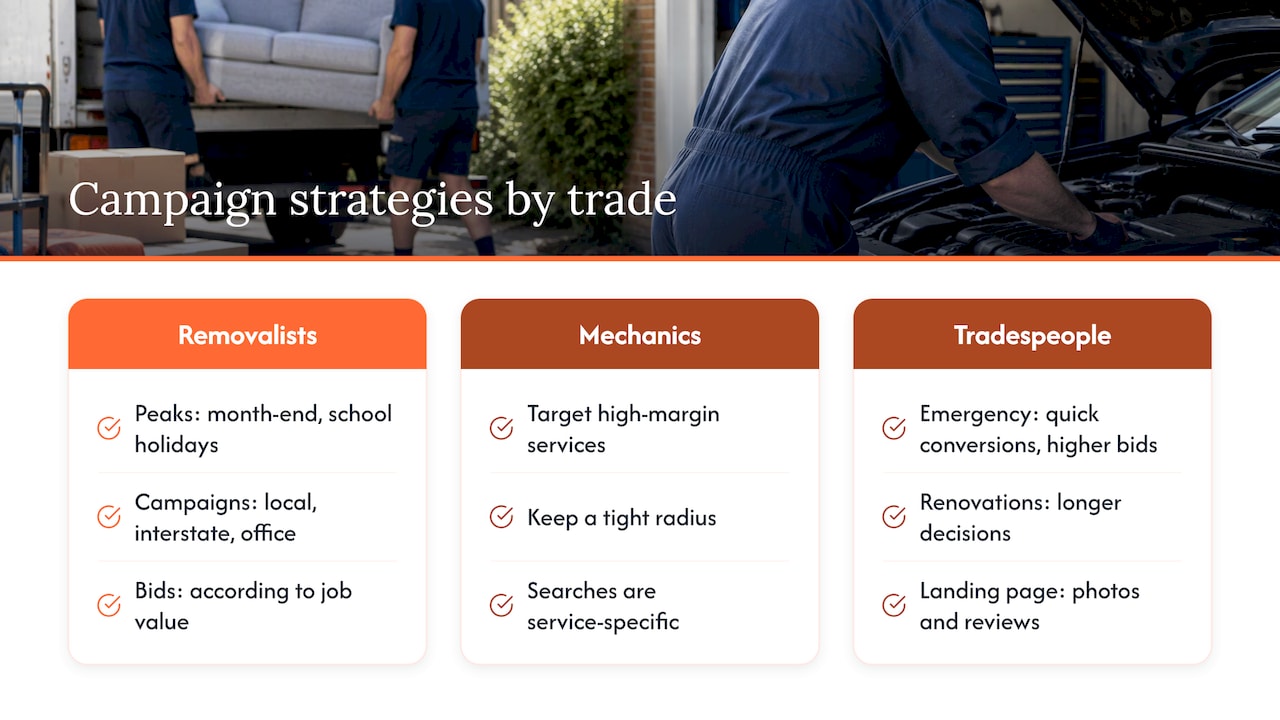
Removalists. Bookings cluster around the end of the month and school holidays, so scheduling and budgets that flex with those peaks are worth the effort. Separate campaigns for local moves, interstate moves and office relocations let you bid according to job value.
Mechanics. Searches are often service-specific (“logbook service”, “brake pads”, “pre-purchase inspection”). Target the high-margin ones and keep the radius tight, because people rarely drive far for a service.
Tradespeople. Emergency searches convert quickly and justify higher bids, while planned work such as a bathroom renovation involves longer decisions and benefits from a landing page with project photos and reviews.
Where a specialist makes the difference
Everything above is learnable, but it is also a weekly job on top of running a business. The trouble many owners describe with agencies is paying for reports without seeing leads. We work differently. Our Google Domination System combines strategic planning, hands-on campaign management and conversion-focused landing pages for Australian service businesses, and you work directly with an experienced specialist, not junior or outsourced staff. Andy has more than 20 years of experience and has helped more than 1,500 companies. Reporting is transparent, with real-time dashboards, and there is no long-term contract: our results-based guarantee is built around that. Our approach is designed to reduce lead costs, with reductions of up to 60% being our claim for clients.

If you want one team handling the ads and the page together, see the Google Domination System. If you also want to be found in organic results, our hybrid Google Ads and SEO service combines paid search and SEO in one plan.
FAQ
How much should a local service business spend on Google Ads?
Start from your numbers: the jobs you want, your close rate and the most you can pay per enquiry. That gives a monthly budget grounded in your margins rather than a round figure. Our Google Ads cost guide explains what Australian businesses typically see.
How long before Google Ads produces leads?
Clicks and calls can start within days of launch, but the account needs a few weeks of data before you can judge it fairly. Early weeks are mostly for trimming irrelevant searches and improving the landing page.
Should I target my whole city or just certain suburbs?
Target the suburbs you can serve profitably, then use location reports to see which produce the best leads. Starting narrow and expanding is safer than starting wide and cutting back.
What is a good cost per lead?
It depends on your job value and close rate, so there is no universal figure. A good cost per lead is one comfortably below what you can afford to pay, as calculated in Step 1.
Sources
The Google Ads Guy guides referenced in this article:
- Location Targeting in Google Ads: A Guide for Australian Businesses
- Display Ads vs Search Ads: Which Suits a Service Business?
- Better Google Ads Leads in 90 Days by Fixing Measurement
- Google Ads Cost in Australia: What You’ll Really Pay
- Landing Pages for Google Ads: What Australian Service Businesses Need
- Enhanced Conversions for Leads: An Australian Setup Guide
- Conversion Tracking Setup for Google Ads: A Practical Australian Guide
- Cost Per Lead in Google Ads: What’s Good and How to Lower It
Recommended
Ready to dominate Google Ads?
Book your free Google Domination Strategy Session and discover how to cut your cost per lead by 40–60%.
Book Free Session